Manual search
Search → select item → adjust quantity → add ingredients → save
Best for control.Trade-off: highest friction.FOOD AI GUIDE
The hardest part of calorie tracking is often searching for every ingredient and typing it in every time you eat. Different meals call for different shortcuts.
Use the quickest method that still gives useful information: a saved meal for repeats, a label or barcode for packaged food, and a photo when the plate is mixed or unfamiliar.
Search → select item → adjust quantity → add ingredients → save
Best for control.Trade-off: highest friction.Open saved meal → adjust portion → save
Best for repeat meals.Trade-off: less useful when the meal changes.Take photo → review estimate → save
Best for mixed or unfamiliar meals.Trade-off: review is still important.People rarely stop tracking because they forgot that food contains calories. They stop when dinner becomes a twenty-minute data-entry task. A late work lunch, a restaurant bowl with six visible ingredients, or a snack eaten between meetings can make searching every item feel more work than the meal itself.
That friction matters because an unlogged meal gives you no record at all. The answer is not to pretend one method is best for every food. It is to choose the quickest method that still gives you information you can use.
Manual logging lets you choose the database entry, set the amount, add ingredients, and adjust the recipe. It is the right fit when you know exactly what you ate and want control over the details.
The cost is obvious at a busy lunch. A sandwich may require bread, meat, cheese, dressing, vegetables, and a side. If you are guessing each item from memory, the process is slow without necessarily becoming more reliable. Manual entry is valuable, but it is not automatically the most accurate choice when the inputs are unknown.
A saved meal is ideal for a breakfast you make most weekdays, a regular coffee, or a lunch you assemble in the same way. Build it carefully once, then reuse it and adjust the portion when needed.
Saved meals become less useful when the recipe changes. A larger scoop of granola, an extra spoon of dressing, or a different restaurant portion can make an old entry look precise while describing a different meal. Reuse is fast; a quick reality check keeps it honest.
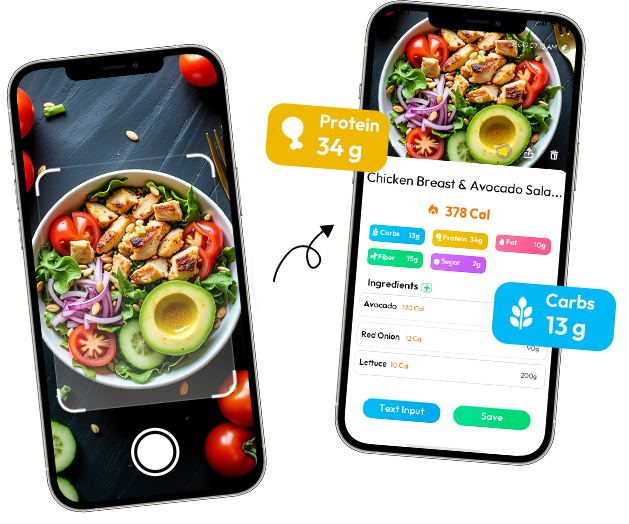
A meal photo is useful when the food is visible but the ingredient list is inconvenient to rebuild. Takeout, mixed plates, leftovers, and unfamiliar restaurant meals are common examples. The photo gives you something concrete to review instead of asking you to remember every ingredient after eating.
It still needs review. Check the visible foods, serving size, cooking method, sauces, and drinks. A photo reduces the number of steps; it does not remove the need to decide whether the result matches your meal.
For packaged foods, a barcode or nutrition label is often the sensible route. The package provides serving information that a photograph cannot see. A protein bar, bottled drink, or frozen meal should not be photographed simply because photo logging exists.
The practical system is mixed: saved meals for repeats, labels for packaged food, manual entries for measured ingredients, and photos for messy meals that are hard to type.
Consider a weekday routine. Breakfast is the same yogurt, fruit, and coffee, so a saved meal handles it. Lunch is a takeout rice bowl eaten between meetings, so a photo creates a usable first pass. A packaged afternoon snack is logged from its label. Dinner is leftovers with an unclear portion, so a photo is followed by a review of the rice and sauce.
No single method was forced onto every meal. That is the point. A tracking routine survives when it fits the day rather than demanding the same amount of effort from breakfast, a snack, and a complicated dinner.
There are meals where a carefully reviewed estimate is more useful than no entry. If you are eating out and cannot know the recipe, a photo preserves the visible evidence. If you are tired and the alternative is abandoning the log, a simple estimate can keep the record continuous.
Do not confuse continuity with certainty. Mark the uncertainty in your own judgment and use the entry for awareness, not as a claim that the number is exact.
Use manual data when you are cooking from a measured recipe, checking a packaged label, preparing repeat meals, or need close control over ingredients. A photo is not a replacement for information you already have.
The useful question is: what information can I realistically collect for this meal? If the answer is a label, use the label. If the answer is a clear photo and a rough portion, use the photo and review it. Removing unnecessary typing is valuable because it makes the whole routine easier to maintain.
Another useful habit is to decide what “enough detail” means before you start. For a packaged snack, the label and quantity may be enough. For a homemade dinner, the recipe may deserve more attention. For a restaurant meal, identifying the main item, side, sauce, drink, and amount eaten may be the best information available. A routine becomes sustainable when it stops asking for precision that the situation cannot provide.
Some people also find that taking the photo before the first bite is easier than reconstructing the meal later. It preserves the original portion, including the sauce and sides, and gives you a reference if you only finish part of it. That small timing choice removes another source of memory-based guessing.
Real tracking includes interruptions. You may eat half a sandwich before remembering the photo, share a plate, or discover that the dinner recipe changed. Record what you know, mark the uncertain part, and keep going. A system that allows imperfect entries is easier to return to than one that treats every exception as failure.
Review the routine once a week. Which meals take too long? Which entries are repeatedly skipped? Move those meals to a faster method, but keep labels and measured recipes where they genuinely add control. Less typing should mean less friction, not less honesty.
The easiest method is not always the fastest method on paper. It is the one you can still use when you are hungry, late for a meeting, or standing in front of a takeaway counter. A saved breakfast removes repeated work. A barcode keeps a packaged snack tied to its label. A photo gives you a useful starting point when a bowl contains too many visible parts to search one by one.
For example, a workday might look like this: use a saved entry for the usual yogurt and coffee, take a photo of a mixed lunch, scan the afternoon protein bar, and manually add a simple piece of fruit. At dinner, photograph the leftovers before eating and adjust the portion if you stop halfway through. The method changes, but the record stays connected to what actually happened.
There is no prize for turning every meal into the same data-entry exercise. Manual logging is worth the extra effort for a measured recipe, a food label, or a meal where ingredient control matters. Photo logging is a practical shortcut for the unfamiliar meals that otherwise disappear from the log. The honest goal is less typing without pretending that an estimate is a measured fact.
A low-friction log is a mix of methods, not a contest to eliminate every tap. Keep control where it matters and use a photo when the alternative is giving up on the meal entirely.
FOOD AI PRODUCT NOTE
Food AI can identify visible meal components and provide a calorie and nutrition estimate to review before logging.
Explore the relevant Food AI tool →